

Vietnam’s textile and garment industry has become one of the most compelling manufacturing destinations in the world, driven less by low cost and more by its evolution into a quality-driven, compliance-ready and deeply trade-connected production base.
The sector closed 2025 with export revenues of USD 46 billion, a 5.6% year-on-year increase, strengthening Vietnam’s position as the world’s third-largest garment exporter. More significantly, it overtook China to become the single largest apparel supplier to the United States market, capturing a 20.6% share of US apparel imports in the January–July 2025 period. This structural shift has been driven by tariff considerations, supply chain diversification strategies among global brands and Vietnam’s growing manufacturing capabilities. It reflects a broader shift in the global apparel supply chain rather than a short-term disruption.
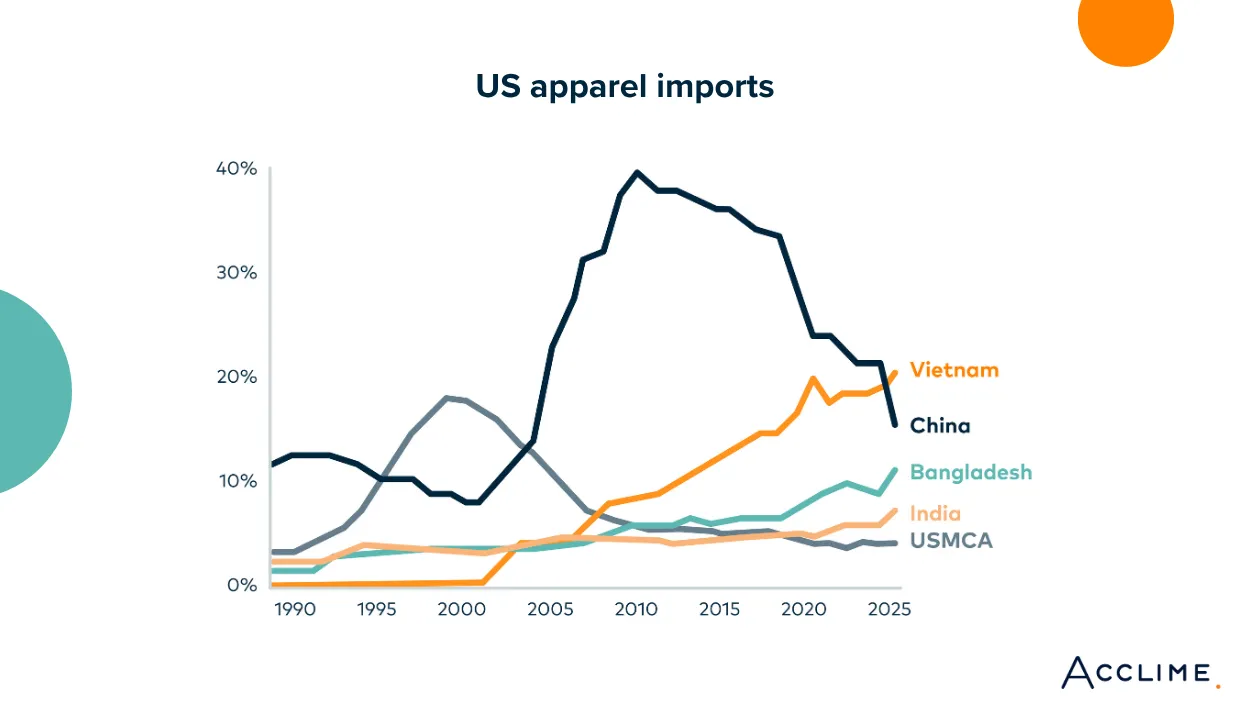
Source: US Office of Textiles and Apparel – OTEXA
Vietnam now accounts for nearly 6% of global textile and apparel exports. The country’s garment industry serves markets across North America, Europe and Northeast Asia, with the United States, the EU, Japan and South Korea collectively absorbing over 80% of output.
Sector-specific supply chain maturity
According to FVSource, Vietnam’s textile and garment industry is organised across three vertically connected tiers: upstream (fibre and yarn production), midstream (fabric production and dyeing) and downstream (cut-and-sew garment manufacturing).
In practice, the industry remains heavily weighted towards the downstream, with 70% of the more than 3,800 textile factories currently operating in the country classified as garment producers, while yarn accounts for 6%, fabric for 17% and dyeing facilities for 4%.
This concentration at the assembly end reflects a structural reality investors should understand clearly. Vietnam remains dependent on imported fibre and fabric for a significant share of its production inputs. That dependence creates both a cost variable and a rules-of-origin consideration relevant to FTA tariff qualification, particularly under the yarn-forward requirements of CPTPP and the fabric-forward requirements of EVFTA.
Product range and specialisation
Vietnamese factories are strongest in apparel: knit tops, fleece, woven shirts, trousers, denim, uniforms, sportswear and light outerwear. Home textiles, towels, bed linen and curtains represent a solid secondary category. Performance synthetics, laminated fabrics and technical textiles are a growing niche, though they remain more mill-dependent and require earlier planning due to higher fabric minimum order quantities.
Factories operate under different commercial models. Free-on-board (FOB) arrangements place input sourcing responsibility with the factory, appropriate for repeat programmes and tariff-sensitive styles. Cut, make, trim (CMT) arrangements suit buyers who want to control fabric sourcing directly. Larger, more established facilities offer original equipment manufacturing (OEM) and original design manufacturing (ODM) services, including product development and access to fabric libraries.
MOQ flexibility in practice
For apparel, minimum order quantity is driven far more by fabric strategy and mill lot size than by country alone. The practical difference between Vietnam and China is the depth and immediacy of the upstream mill base. It is sometimes claimed that Vietnamese factories offer extremely low MOQs, around 250 to 600 pieces, but these are exceptions rather than the rule. A more typical MOQ for many Vietnamese full-package factories is around 1,000 pieces per style per colour, especially when using custom fabrics, multiple colour variants or intricate finishing. Smaller factories or batch-oriented producers may accept 300 to 500 pieces for simpler garments using basic knits, few trims and stock fabrics.
Regulatory and compliance framework
Compliance expectations in Vietnam’s textile sector span two connected areas: environmental standards and labour conditions, both of which are tightening in step with the requirements of major export markets.
Environmental compliance
Factories face stricter wastewater discharge standards, hazardous chemical controls and occupational-safety requirements. Brands shipping to the EU/UK/US are also building traceability and emissions reporting into vendor contracts. For EU-bound programmes, expect documentation to support deforestation-related due-diligence and carbon disclosures. International certifications are increasingly expected by major buying groups, including:
- OEKO-TEX Standard 100 (chemical safety)
- GOTS (Global Organic Textile Standard)
- WRAP (Worldwide Responsible Accredited Production)
- BSCI (Business Social Compliance Initiative)
- SA8000 (Social Accountability)
Labour framework
Vietnam’s statutory minimum wages are organised across four geographic zones, with the highest rates in urban industrial centres such as Ho Chi Minh City and Hanoi. Entry-level wages currently range from USD 150–250 per month, while experienced operators, factoring in overtime and productivity incentives, can reach USD 350–600 per month. By regional standards, this represents a mid-range cost structure, below China and above Bangladesh. Its productivity profile means that, for mid-complexity products, cost-per-unit outcomes are often better than the wage comparison alone would suggest.
Peer country comparisons
Vietnam’s position becomes clearer when set against its main regional competitors on cost, capability and risk:
| Factor | China | Vietnam | Bangladesh | India |
|---|---|---|---|---|
| Market Role | Automation & tech textiles | Mid-to-high complexity, FTA-enabled | High-volume basics | Raw material-integrated |
| Key Strength | Scale & speed | Skilled labour + FTA network | Lowest labour cost | Farm-to-fashion chain |
| Key Risk | Tariff exposure + geopolitics | Fabric import dependency | LDC graduation risk | Fragmented logistics |
| Entry Wage (USD/mo) | 240–390 | 150–250 | 113–133 | Varies by state |
| Exp. Worker (USD/mo) | 1,000–1,300+ | 350–600+ | Variable | State variation |
Source: FVSource compilation, 2025
Technology transformation
The sector is mid-way through a meaningful technology upgrade cycle. Transport robots, automated cutting systems and smart production management software are being deployed across leading factories. VITAS has noted that a single transport robot can replace five to six workers, and that productivity-per-worker has improved materially as operators are trained to manage multiple machines simultaneously. These investments are raising the floor on what factories can reliably deliver and widening the gap between tier-one suppliers and the broader base.
Regional concentration and location strategy
The northern cluster spans Hanoi, Bac Ninh and Hai Phong, with port access through Lach Huyen. The southern cluster covers Ho Chi Minh City, Binh Duong and Dong Nai, served by the deep-sea terminal at Cai Mep Thi Vai. Both clusters are located within competitive trucking distance to their respective ports, enabling reliable container consolidation and predictable lead times.
Long-established industrial parks within these clusters offer an additional advantage in workforce quality. Operator training depth, supervisory experience and retention rates are meaningfully higher in these zones than in newer, more peripheral sites. This directly affects production ramp-up timelines and defect rates on first orders.
What this means for buyers and manufacturers
Over the past two decades, Vietnam has built one of the most capable textile and garment manufacturing bases in Asia. The reasons are practical, and largely structural: competitive labour costs, a workforce experienced across woven, knit and technical categories, suppliers willing to accommodate smaller and mid-sized orders and tariff advantages under trade agreements such as the EVFTA and CPTPP. For most international buyers, these factors now justify treating Vietnam as a primary production base rather than a secondary option.
A thorough supplier evaluation, weighing capability, financial stability and compliance record together, is the strongest foundation for entering the market. Certifications and audit standards are best confirmed before volume is committed, and a degree of supplier diversification helps ensure no single factory becomes a point of failure. Treating Vietnamese partners as an extension of the business, rather than a line item to renegotiate each season, tends to produce the most durable sourcing relationships. For manufacturers weighing cost, quality and resilience, Vietnam offers a credible answer on all three, provided the groundwork is done properly.
Download the full industry report Vietnam’s Next Manufacturing Frontier (2026) | Acclime Vietnam to explore more insights about Vietnam’s textile and garment industry.
Reach out to our experts:
- Rizwan Khan – Managing Partner – [email protected]
- Vlad Savin – Partner – [email protected]
- Thao Nguyen – Senior Manager, Licensing and Corporate Secretarial – [email protected]
- Phuong Nguyen – Senior Manager – Payroll and HR Consulting – [email protected]
- Mai Vu – Director – Accounting & Tax – [email protected]


